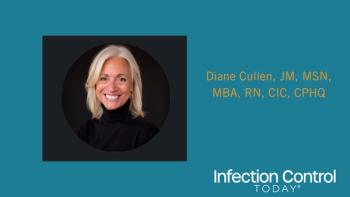
What happens when one disinfectant cannot satisfy every IFU? At AHE in New Orleans, Diane Cullen discusses weighted risk assessment, documenting difficult decisions, and why infection prevention and EVS need to work together.
Ecolab introduces OxyCide Daily Disinfectant Cleaner, a non-bleach sporicide developed for daily use in healthcare settings. OxyCide is proven effective in killing a broad spectrum of harmful bacteria and viruses, including Clostridium difficile (C. difficile) spores in 3 minutes and multidrug-resistant organisms and viruses in 5 minutes or less, helping hospitals to reduce the risk of healthcare-associated infections (HAIs).
OxyCide is proven to kill 33 different types of bacteria and viruses in five minutes or less and will help generate efficiency gains and savings in hospitals by eliminating the need to use multiple solutions on the different surfaces within operating rooms, patient rooms and common areas, says Dr. Andy Cooper, vice president of research, development and engineering at Ecolab. Using a sporicide everywhere, everyday will help our customers be more effective in killing C. difficile spores and other dangerous pathogens.
In a study presented at IDWeek 2012, daily cleaning using OxyCide resulted in a 36.5 percent reduction of viable bacteria on hospital surfaces compared to other disinfectants. OxyCide leaves no visible residue and, unlike bleach, does not require rinsing. It is non-corrosive on most hard surfaces, including high-touch objects such as over-bed tables, bedrails, door handles and bathroom surfaces. In addition, OxyCides lockable product cabinet and closed-loop dispensing system offer safer product handling for staff, helping to reduce the risk of spills by eliminating the need for manual pouring and mixing.
Source: Ecolab