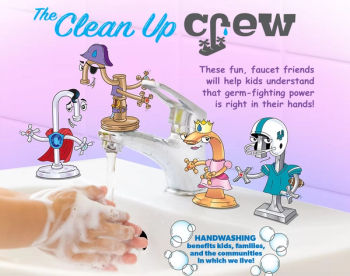
Artist and designer Matthew Caliman shares how personal loss inspired the Cleanup Crew, a handwashing education project using cartoon faucets, songs, and games to help families revisit an essential health message.
The Healthcare Laundry Accreditation Council (HLAC), which inspects and accredits healthcare laundries, recently offered suggestions to ensure that textiles remain hygienically clean from processing, distribution and on to patient use.
"HLAC standards ensure that textiles that are delivered by an accredited facility will arrive (at the hospital) hygienically clean - free of pathogens in sufficient numbers to minimize risk of infection," writes John Scherberger, CHESP, REH, in an article, "Handling Textiles in the Hospital Environment," in the March issue of Health Facilities Management magazine. "But it is incumbent upon each facility to ensure that they remain clean once they are delivered to the facility."
Scherberger, an HLAC board member, adds, "Each hospital must have a policy and procedure dealing with the transportation and storage of clean textiles as well as for addressing the transportation and storage of contaminated textiles. Simply put, once textiles are removed from a clean-linen cart or storage room and taken into a patient room, they are contaminated."
In the article he offers several suggestions to prevent contamination. Among them:
- To never carry clean or soiled textiles against a uniform
- To never carry clean or contaminated textiles cradled in unclothed arms
- To never stage clean textiles outside of a room or on a shelf outside of a room because "contaminated surfaces abound"
- Always ensure that textiles are stored on shelving units that are covered -- even in clean storage rooms, textiles should always be covered
"The skin comes in contact with textiles more in a hospital than many realize," Scherberger says. "Whether textiles come from an HLAC-accredited laundry plant or an on-premises laundry, ensuring hygienically clean textiles from processing, distribution and on to patient use cannot be taken lightly."
Source: Healthcare Laundry Accreditation Council (HLAC)