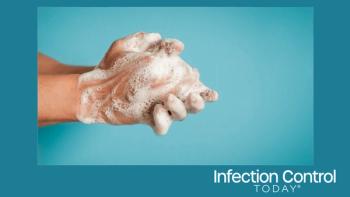
Elaine Larson, PhD, RN, FAAN, CIC, of the School of Nursing at Columbia University, reviews the book, Clean Hands Save Lives by Thierry Crouzet and Tom Clegg in a recent issue of the journal Antimicrobial Resistance and Infection Control. The book tells the story of Dr. Didier Pittet’s contributions to global health through his work on hand hygiene.
As Larson writes, "Research demonstrating the efficacy of alcohol hand hygiene has been published around the world, starting in the 1970s and continuing through today-examples are from the UK, Croatia, Finland, The Netherlands, Germany, Austria, South Africa, Japan and the United States. Additionally, a hand hygiene guideline recommending alcohol-based products was first published in 1988 and then again in 1995, well before the CDC and WHO guidelines recommended alcoholic solutions. Hence, Dr. Pittet sits on the shoulders of others who came before him to establish a body of evidence of the efficacy of alcohol-based hand hygiene products. But an important lesson for the scientific community is that conducting and publishing rigorous research is not sufficient for reaching that tipping point which results in changed behaviour and culture. The publication in 2002 of CDC’s hand hygiene guideline, for example, had only minimal impact on healthcare personnel hand hygiene behavior. Didier took up the ‘cause’ of hand hygiene in the early 1990s and soon recognized that changing habits so engrained as hand hygiene required not only evidence of effectiveness but the application of multiple behavioural and systems-level strategies."
Larson adds, "This book describes in colorful and rather dramatic (even evangelistic) terms the unfolding and evolution of Dr. Pittet’s work and contributions. It is not, however, a book for scientists seeking factual data. Rather it is a saga of a charismatic and committed individual who was in the right place at a tipping point and had a prepared mind and the passion to help make hand hygiene globally accessible and demonstrate its impact ... All in all, this book accomplishes the monumental and worthy task of telling the story of hand hygiene and its role in reducing morbidity and mortality through the tipping point work of a Dr. Pittet, a visionary scientist and tireless humanitarian."
To read further in Antimicrobial Resistance and Infection Control, CLICK HERE.
Reference: Larson E. Review of ‘Clean Hands Save Lives,’ written by Thierry Crouzet. Antimicrobial Resistance and Infection Control 2014, 3:13.