News|Articles|April 23, 2024

Healthcare Sterile Processing Association 2024 Highlights

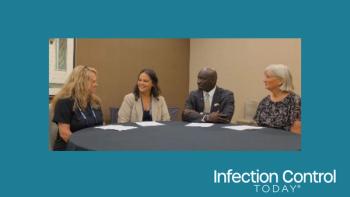
Check out the highlights so far from Infection Control Today at the Healthcare Sterile Processing Association held in Las Vegas, Nevada, from April 20 to April 23, 2024.

Infection Control Today (ICT) is attending the Healthcare Sterile Processing Association (HSPA) Annual Conference in Las Vegas, Nevada, from April 20 to April 23, 2024.

Three articles from the conference so far include:

Streamlining Loaner Equipment Management: A Case Study From Siriraj Piyamaharajkarun Hospital

CSSD at Siriraj Piyamaharajkarun Hospital presents a poster at HSPA 2024, outlining efforts to streamline loaner equipment management for surgical efficiency.

Sterile Processing Technicians: Preparing for Survey

Jill Holdsworth, MS, CIC, FAPIC, CRCST, NREMT, CHL, and Katie Belski, BSHCA, CRCST, CHL, CIS, spoke at the HSPA Annual Conference about being survey-ready. Listen to ICT's interview to learn more!

Preventing Surgical Site Infection in the OR: A Comprehensive Approach to Point-of-Use Instrument Care

Lisa Pawlowski, DNP, MSN-Ed, RN, CRMST, presents a poster at the HSPA 2024 Conference highlighting an evidence-based bundle that reduces SSIs by improving post-use instrument care and storage practices.

Related to this article

Dyan Troxell, MSN, RN, director of clinical education at HandCraft Linen Services; J.J. Odom, MBA, CHESP, CMIP, T-CHEST, university director of buildings and grounds for UConn Health and chair-elect of the AHE Board; and Jenna Rivers, MPH, CPH, CIC, manager of infection prevention and control at Moffitt Cancer Center in Tampa, Florida.
At AHE Exchange 2026, ICT spoke with experts representing commercial laundry services, EVS, and infection prevention about the systems behind a successful reusable linen program. They discuss linen quality, reject rates, unnecessary waste, frontline education, data, PAR levels, infection prevention oversight, and why strong relationships between health care facilities and their laundry providers matter.
Sadé L. Rolon, MBA, CMIP, CHESP, T-CHEST, T-CSCT, the regional director of operations for Sodexo’s Healthcare Division,  Julie Mangino, MD, infectious disease specialist at The Ohio State University Medical Center, Columbus, OH,  James “JJ” Odom, MBA, CHESP, CMIP, T-CHEST, the university director of buildings & grounds at UConn Health, Farmington, Connecticut,  Christopher Dugard, MS, director for the Division of Infection Control Devices in the Office of Surgical and Infection Control Devices, FDA/Center for Devices and Radiological Health.  and Elizabeth “Liz” Claverie, MS, (retired CAPT, 0-6) vice president, regulatory strategic liaison for Steris.  (Image credit: Author)
Can a UV-C robot make up for a surface that wasn't properly cleaned? Experts say that's the wrong way to think about the technology. UV-C can provide an additional layer of microbial reduction, but factors including shadows, distance, positioning, and exposure time mean it cannot replace thorough manual cleaning and disinfection.
Sadé L. Rolon, MBA, CMIP, CHESP, T-CHEST, T-CSCT, the regional director of operations for Sodexo’s Healthcare Division,  Julie Mangino, MD, infectious disease specialist at The Ohio State University Medical Center, Columbus, OH,  James “JJ” Odom, MBA, CHESP, CMIP, T-CHEST, the university director of buildings & grounds at UConn Health, Farmington, Connecticut,  Christopher Dugard, MS, director for the Division of Infection Control Devices in the Office of Surgical and Infection Control Devices, FDA/Center for Devices and Radiological Health.  and Elizabeth “Liz” Claverie, MS, (retired CAPT, 0-6) vice president, regulatory strategic liaison for Steris.  (Image credit: Author)
During an expert panel at Exchange26 on whole-room microbial reduction technologies, regulatory and health care leaders discussed the distinction between FDA and EPA oversight, what constitutes a medical device claim, the risks surrounding unauthorized or off-label claims, and why IP and EVS professionals should verify a device's regulatory status rather than relying solely on vendor presentations.
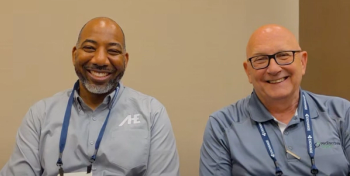
Donald Sipp, Jr, MBA, RESE, CHESP, CHTI-2, CMIP, PMP, and David Green  (Image credit: author)
“Cutting” waste shouldn’t mean cutting people. At AHE Exchange26, David Green and Donald Sipp explored how EVS departments can improve performance by strengthening workplace culture, empowering employees, eliminating inefficient processes, and understanding EVS’s critical role in patient throughput. One case study showed bed turnaround times falling from nearly 2 hours to less than an hour, but the larger lesson wasn't simply about speed. High-performing EVS operations begin with a strong foundation.