|Articles|July 25, 2011

Nurse Uniform Contamination Increases Over Duration of Shifts

Nurses' uniforms can act as a reservoir of infections, with the areas around the pockets, cuffs and aprons the most contaminated. Investigators from the Public University of Navarra, the University of Vavarra Clinic, and the University of Vavarra Clinic in Pamplona, Spain, compared the contamination levels as well as measured the influence of the number of shifts as uniform was used in its contamination.

The standard nurses' uniform studied consisted of a dress and pinafore apron with the "scrub dress" type of apparel. Microbiological cultures were collected from uniforms of 88 nurses (58 using traditional uniform and 30 using scrub dress) in a university hospital, during their work in a one-month period. Cultures were obtained using Count-tact plates (BioMérieux) plates (25 cm2). The culture media were incubated for five days at room temperature. After the incubation period bacterial count and type of bacteria colonizing the uniform were evaluated by a microbiologist. Reading was provide in colony forming units (cfus).

The average count was 42,82 fcu/cm2. According to the researchers, there were no differences in the count between both types of uniform.(P=0,504). There was a positive correlation between the number of days and microbiological count (r=0,224, P=0,036). The average count was 44,36 cfu/cm in those nurses using the uniform for one or two shifts, and at 65,20 cfu this difference was statistically significant. (P=0,031).

The researchers conclude that there are no differences in microbiological contamination between standard or scrub uniform. The main differences incontamination appeared in those nurses that used the same uniform for more than two shifts. They add that hospitals should provided nurses with enough uniforms to change before every shift or at least every two shifts. Their research was presented at the International Conference on Prevention & Infection Control (ICPIC) held in Geneva, Switzerland June 29-July 2, 2011.

Reference: F Guillen-Grima, A Aguinaga-Perez, J Nunez-Cordoba and C Sara. Influence of type of uniform and days of usage in microbiological contamination of nurses uniform in a university hospital. Presentation at International Conference on Prevention & Infection Control (ICPIC). BMC Proceedings 2011, 5(Suppl 6):P317


Related to this article

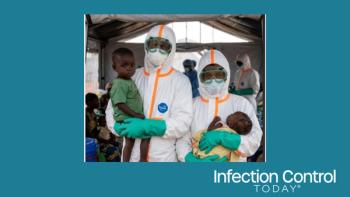
Infection preventionists in full PPE with children in DRC.  (Image credit: author with AI)
Nearly 4 months into the DRC's Bundibugyo virus disease outbreak, some indicators suggest transmission may be slowing. But shifting hotspots, treatment-center capacity problems, community deaths, and incomplete surveillance data show why national case totals alone cannot determine whether containment has been achieved.
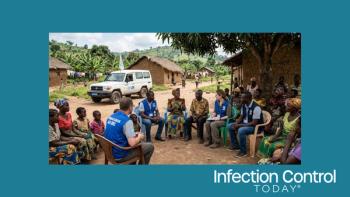
Health care workers from the US speaking with other health care workers in DRC.  (Image credit: author with AI)
Is the Ebola outbreak in the DRC getting better? The answer depends on which numbers you examine. Several important indicators are moving in the right direction, including slower case growth and a declining Rₜ. But major gaps remain in contact tracing, testing, community deaths, safe burial coverage, and treatment capacity in some of the hardest-hit areas. ICT takes a deeper look at the latest outbreak data and why the numbers suggest cautious optimism, not victory.
Dyan Troxell, MSN, RN, director of clinical education at HandCraft Linen Services; J.J. Odom, MBA, CHESP, CMIP, T-CHEST, university director of buildings and grounds for UConn Health and chair-elect of the AHE Board; and Jenna Rivers, MPH, CPH, CIC, manager of infection prevention and control at Moffitt Cancer Center in Tampa, Florida.
At AHE Exchange 2026, ICT spoke with experts representing commercial laundry services, EVS, and infection prevention about the systems behind a successful reusable linen program. They discuss linen quality, reject rates, unnecessary waste, frontline education, data, PAR levels, infection prevention oversight, and why strong relationships between health care facilities and their laundry providers matter.
A group of students raising their hands in class during a lecture  (Adobe Stock 292282454 by Mediteraneo
How do you celebrate an infection that never happened? That's one of the unusual challenges infection preventionists share with teachers. Both can spend their careers changing outcomes they may never see. Both educate people who don't always want to listen. Both are second-guessed. Both face burnout. And both must somehow keep remembering why they started.