|Articles|July 21, 2004

Triosyns T-1000 Respirator Demonstrates Protection Against SARS Virus in Independent Tests by Canadian Health Bureau

BURLINGTON, Vt. -- Triosyn Corp., a developer of products aimed at protecting against microbial threats, has announced that tests conducted by Health Canadas national microbiology laboratory show that Triosyn T-1000 series respirators protect against Severe Acute Respiratory Syndrome (SARS). The third-party tests, which validate Triosyns extensive testing, demonstrate that Triosyns filtration technology eliminates SARS viral particles from the air passing through the facemask.

Health Canada, the Canadian federal bureau of health, conducted independent testing on the efficacy of Triosyns facemask filter to protect against SARS coronavirus, the viral agent responsible for SARS. The test involved blowing air contaminated with the SARS coronavirus through the facemask and analyzing the airstreams that passed through the facemask for the presence of viral particles. Tests were conducted at three different exposure periods: 15, 60 and 120 minutes.

Health Canadas test results show that no coronavirus particles were detected in the airstreams that passed through the Triosyn T-1000 series respirator during any of the three different exposure periods.

Health Canadas tests confirm that the T-1000 is the worlds first personal facemask that can provide protection against the potentially deadly airborne SARS virus, said Pierre Jean Messier, CEO of Triosyn Corp. Police forces in North America are currently using the T-1000 facemask and we are introducing it throughout the world.

SARS is a potentially deadly respiratory virus, which currently has no vaccine. More than 8,400 people in 29 countries have contracted SARS, and more than 900 people have died worldwide since the emergence of SARS in November 2002. The World Health Organization (WHO) states that the virus can be transmitted through the air, via coughing or sneezing, on tiny droplets of bodily fluids.

The Triosyn T-1000 respirator, a disposable personal facemask manufactured with an innovative antimicrobial technology to protect the filtration materials from microbial deterioration, is certified by the National Institute for Occupational Safety and Heath (NIOSH) as an N95 filtering facepiece respirator. It is also CE certified in Europe.

Source: Triosyn Corp.


Related to this article

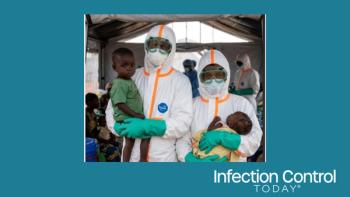
Infection preventionists in full PPE with children in DRC.  (Image credit: author with AI)
Nearly 4 months into the DRC's Bundibugyo virus disease outbreak, some indicators suggest transmission may be slowing. But shifting hotspots, treatment-center capacity problems, community deaths, and incomplete surveillance data show why national case totals alone cannot determine whether containment has been achieved.
Health care workers from the US speaking with other health care workers in DRC.  (Image credit: author with AI)
Is the Ebola outbreak in the DRC getting better? The answer depends on which numbers you examine. Several important indicators are moving in the right direction, including slower case growth and a declining Rₜ. But major gaps remain in contact tracing, testing, community deaths, safe burial coverage, and treatment capacity in some of the hardest-hit areas. ICT takes a deeper look at the latest outbreak data and why the numbers suggest cautious optimism, not victory.
Dyan Troxell, MSN, RN, director of clinical education at HandCraft Linen Services; J.J. Odom, MBA, CHESP, CMIP, T-CHEST, university director of buildings and grounds for UConn Health and chair-elect of the AHE Board; and Jenna Rivers, MPH, CPH, CIC, manager of infection prevention and control at Moffitt Cancer Center in Tampa, Florida.
At AHE Exchange 2026, ICT spoke with experts representing commercial laundry services, EVS, and infection prevention about the systems behind a successful reusable linen program. They discuss linen quality, reject rates, unnecessary waste, frontline education, data, PAR levels, infection prevention oversight, and why strong relationships between health care facilities and their laundry providers matter.
A group of students raising their hands in class during a lecture  (Adobe Stock 292282454 by Mediteraneo
How do you celebrate an infection that never happened? That's one of the unusual challenges infection preventionists share with teachers. Both can spend their careers changing outcomes they may never see. Both educate people who don't always want to listen. Both are second-guessed. Both face burnout. And both must somehow keep remembering why they started.