|Articles|August 19, 2022

Weekly Rounds: Interviews With Ambassador Birx, Ultrasound Transducer Decontamination, and More

Take 5 minutes to catch up on Infection Control Today’s highlights for the week ending August 19.

Here are 5 highlights from ICT®’s wide-ranging coverage of the infection prevention and control world. Everything from interviews with known opinion leaders, to the news that infection preventionists and other health care professionals can use on their jobs.

Monkeypox: Birx Says We Are Not Ready for a New Pandemic

Ambassador Deborah Birx, MD, told Infection Control Today® exclusively, “Every mistake that we made with COVID-19 in January and February of 2020, repeated in real time with monkeypox.”

Viewpoint: We Cannot Afford to Surrender to COVID-19 Now

Last week the Centers for Disease Control and Prevention relaxed recommendations which neither control or prevent a rapidly evolving and disabling disease, COVID-19. However, we must maintain effective efforts to control spread of the virus.

Effective Ultrasound Transducer Decontamination Requires Education and Accountability

Using an ultrasound transducer may look easy, but it is a highly specialized skill, and to use a transducer requires education, accountability, and competency checks to occur regularly.

The Best Way to Start an IP Role Is With The Joint Commission: One IP's Experience

The first day as an infection preventionist can be nerve wracking, but what happens when The Joint Commission is there the same day?

Birx: Every New Infection, Loss Should be Considered a Failure of US Medical Infrastructure

Ambassador Deborah Birx said in an exclusive interview with ICT® that there are “extraordinary structural barriers in the US to access” medical care. Individuals may have insurance, but they cannot access care.



Related to this article

A group of students raising their hands in class during a lecture  (Adobe Stock 292282454 by Mediteraneo
How do you celebrate an infection that never happened? That's one of the unusual challenges infection preventionists share with teachers. Both can spend their careers changing outcomes they may never see. Both educate people who don't always want to listen. Both are second-guessed. Both face burnout. And both must somehow keep remembering why they started.
Donald Sipp, Jr, MBA, RESE, CHESP, CHTI-2, CMIP, PMP, and David Green  (Image credit: author)
“Cutting” waste shouldn’t mean cutting people. At AHE Exchange26, David Green and Donald Sipp explored how EVS departments can improve performance by strengthening workplace culture, empowering employees, eliminating inefficient processes, and understanding EVS’s critical role in patient throughput. One case study showed bed turnaround times falling from nearly 2 hours to less than an hour, but the larger lesson wasn't simply about speed. High-performing EVS operations begin with a strong foundation.
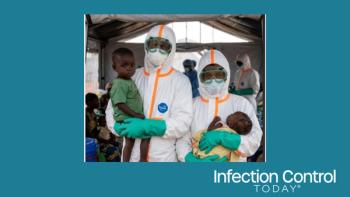
Infection preventionists in full PPE with children in DRC.  (Image credit: author with AI)
Nearly 4 months into the DRC's Bundibugyo virus disease outbreak, some indicators suggest transmission may be slowing. But shifting hotspots, treatment-center capacity problems, community deaths, and incomplete surveillance data show why national case totals alone cannot determine whether containment has been achieved.