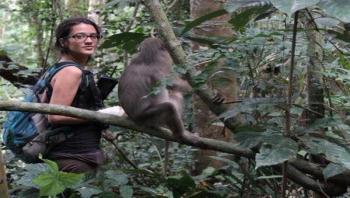
Humans, like most non-human primates, are social beings and profit in many respects from the benefits of a community. However, their closeness to conspecifics is an opportunity for pathogens and parasites to infect new hosts. It is therefore advantageous to avoid sick individuals. Scientists including Clémence Poirotte from the German Primate Center investigated how mandrills, an Old World monkey species inhabiting equatorial rainforests of Gabon, recognize conspecifics infected with intestinal parasites and avoid an infection. The monkeys are able to smell an infected group member and consequently groom them less than healthy individuals. This component of the "behavioral immune system" of mandrills plays a crucial role in the co-evolution of host and parasite (Science Advances 2017).