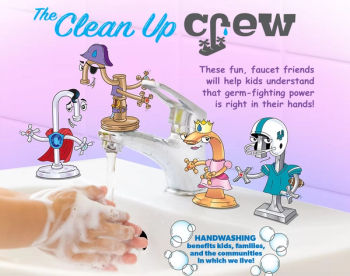
Artist and designer Matthew Caliman shares how personal loss inspired the Cleanup Crew, a handwashing education project using cartoon faucets, songs, and games to help families revisit an essential health message.
Health care–associated infections (HAIs) remain underestimated, driven by evolving pathogens, environmental reservoirs, and biofilm persistence. Experts argue outdated data and overreliance on hand hygiene obscure the true, growing burden of preventable infections.
For nearly 2 decades, the health care industry has cited the same sobering statistic: 1.7 million health care-associated infections (HAIs) and 99,000 deaths annually in the US. This translates to roughly 1 death every 5 minutes, 24/7, 365 days every year. Despite this staggering toll, these infections rarely make headlines, trigger emergency declarations, or appear prominently in national public health debates.
These figures are based on the
But here is the sobering question: Do those numbers still reflect the reality based on present-day preventable hospital-associated infections (pHAIs)?
The epidemiological landscape has shifted dramatically. If anything, the burden of pHAIs is probably significantly underestimated. Surveillance is not lacking; the risk environment has fundamentally changed.
A Different Microbial Era
When Kleven’s analysis was published, the pathogens of concern in acute care hospitals were materially different. Since then, health care facilities have faced challenges such as:
Many of these organisms exhibit characteristics that were not fully appreciated or understood in earlier surveillance reports, including:
In short, the microbial burden and pathogenicity in health care environments have not remained static; they have evolved considerably.
The Overlooked Reservoirs: Sinks, Drains, Toilets, and Floors
Mounting evidence implicates environmental reservoirs in hospitals as active sources of pathogen transmission.
Splash and aerosolization from contaminated drains can disseminate organisms to adjacent surfaces, medical equipment, and patient care zones. Likewise, toilet plume aerosolization can disperse microbes beyond the bowl, especially in high-use, shared facilities.
Floors have long been recognized as reservoirs of pathogens; however, the prevailing attitude, “what is on the floor stays on the floor,” has been shown to be clearly incorrect. Studies published within the last 10 years have shown that pathogens on the floor rapidly cross-contaminate above-floor surfaces throughout the patient care zone, where incidental hand contact can easily result in cross-contamination.
These reservoirs challenge a long-standing assumption: that environmental contamination is transient and superficial. In reality, many hospital surfaces are continuously being reseeded and contaminated. Researchers have determined that “If you’re not disinfecting for biofilm, you’re not disinfecting!”
The Hand Hygiene Paradox
Infection prevention programs have understandably emphasized
Here’s the paradox:
Without rigorous proactive environmental surface hygiene and pathogen reservoir control, hand hygiene alone becomes a revolving door, an expensive, incomplete, and ineffective mitigation strategy. Hand hygiene is necessary; however, on its own, it is akin to the old Einstein anecdote: Doing the same thing over and over again and expecting a different result is the definition of insanity.
Why the Numbers Don’t Add Up
Several systematic factors suggest that legacy pHAI’s underestimate preventable harm:
Underdetection: Not all infections are captured in surveillance. Many postdischarge infections go unreported.
Shifting risk populations:
Antibiotic resistance: Resistant organisms prolong the length of stay, increase environmental shedding, and complicate eradication
Environmental persistence: Modern pathogens survive longer on dry surfaces and in plumbing systems than previously understood
Biofilm tolerance: Standard surface disinfection is rarely validated against mature biofilm reservoirs. Taken together, it is difficult to argue that a dataset (estimate) compiled from the 1990s HAIs fully reflects the microbial challenges hospitals face in 2026.
The Economics of environmental neglect: Hospital risk managers focus on:
Yet
A multimodal systems-based approach: Reducing pHAIs requires moving beyond an emphasis on a single intervention. An effective proactive strategy must include:
Hand hygiene remains a key component of any infection prevention program; however, hand hygiene alone, without including environmental hygiene, is a waste of time, money, and effort.
If the pathogens, the reservoirs, and the risks have changed, then relying on legacy numbers and a single-point intervention does not align with present-day reality.
The numbers don’t add up! It is time to reassess not only how many infections are preventable, the impact on the bottom line, but also how prevention itself is defined and implemented.