The White House says its approach stems from an HHS scientific assessment comparing US childhood immunization recommendations with those in peer developed countries. The administration says the United States recommends more childhood vaccines than any peer nation and that many other countries maintain high vaccination rates through public trust and education rather than mandates.
Critics question whether the number of vaccines alone is an appropriate measure for comparing national immunization programs.
“No one can predict which disease a child will get, and not having ready access to universal health care makes comparisons between European and the U.S. health care systems problematic at best,” Kavanagh told ICT.
NFID similarly cautioned against applying another country's approach without accounting for differences in populations, disease epidemiology, health care systems, and immunization programs.
“The number of vaccines or doses on a schedule is not a measure of whether that schedule is sound,” NFID stated. Instead, the organization said each recommendation should be evaluated according to its risks and benefits, as well as the diseases US children face.
That distinction is particularly relevant to infection preventionists. Vaccination recommendations do not operate independently of disease prevalence, access to care, health disparities, community immunity, and the ability of health systems to identify and respond to outbreaks.
Autism Claims Again Enter the Vaccine Debate
The executive order arrives amid renewed administration discussion of vaccines and autism, despite a large body of scientific evidence finding no causal association between vaccination and autism.
The controversy traces largely to a 1998 paper proposing a relationship between MMR vaccination and autism that was subsequently retracted.
“It was also suggested that this may decrease rates of autism,” Kavanagh said. “The original small study that suggested a linkage between vaccines and autism has been thoroughly discredited and has been described by the BMJ Editor as being fraudulent. In the city of Yokohama, Japan, when individual MMR components were administered separately, there was an increase, not a decrease in autism. There have been at least 35 studies involving millions of children that have failed to show a link between the 2.”
Large epidemiologic investigations conducted since then have consistently failed to demonstrate that MMR vaccination causes autism. A Danish population study involving 537,303 children found no association between MMR vaccination and autism spectrum disorder.
A much larger Cochrane review examining 138 studies involving more than 23 million children concluded that MMR, MMRV, and MMR plus varicella vaccines were effective and found no evidence of an increased autism risk. The autism analysis itself included nearly 1.2 million children.
The American Medical Association (AMA) reiterated that point following the executive order.
“Extensive evidence from decades of scientific studies shows no link between vaccines and autism,” AMA president Willie Underwood III, MD, MSc, MPH, said in the organization's response.
The AMA also warned that changing an established vaccination schedule without credible supporting evidence could undermine public confidence and endanger children's health.
A Public Health Achievement at Risk?
For Alexandra Peters, PhD, president of Clean Hospitals, Institute of Global Health, University of Geneva, Geneva, Switzerland, the debate must also be viewed against the historical success of vaccination.
“For many decades, thanks to mass vaccinations, people in the US had the privilege of living in a country where many preventable infectious diseases virtually didn’t exist,” Peters said. “In order to see the damage that measles, polio, pertussis, tetanus, and even smallpox before it was eradicated caused, people would have to travel to ‘poor’ countries.”
That success can create its own challenge for public health. When diseases become uncommon, subsequent generations may have little firsthand understanding of the morbidity and mortality those diseases once caused.
Peters warned that declining vaccination coverage was already occurring before the new executive order.
“Now there are affluent communities in parts of the US with lower vaccination rates than South Sudan,” she said, “and that was before this latest attack on public health.”
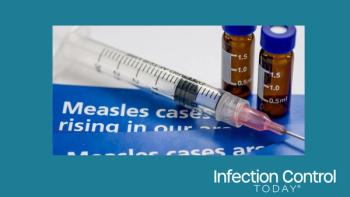
The timing is particularly significant because the US has recently experienced substantial measles activity. CDC's report on the large 2025 Texas outbreak documented 762 confirmed cases, 99 hospitalizations, and 2 measles-associated deaths. Investigators emphasized that high 2-dose MMR vaccination coverage remains the most effective public health intervention for preventing measles.
Peters sees the policy change as a reversal of one of public health's most important advantages: preventing disease rather than paying for its consequences.
“It’s a tragedy when a country with the means to stay healthy makes a public health decision that not only costs taxpayers more but damages the health of its population,” she said.
What This Means for Infection Prevention
The executive order does not, by itself, rewrite every state vaccination requirement. States establish school vaccination requirements, although the order advises states to consider revising their laws to reflect the administration's new recommendations. It also directs federal agencies to advance the new recommendations within their respective authorities.
That means implementation, coverage, availability, state policies, and clinical guidance will be important areas for infection preventionists to watch.
For IPs, pediatric clinicians, pharmacists, school health professionals, and public health departments, the consequences could eventually extend into outbreak preparedness. Lower vaccination coverage can mean larger susceptible populations, increasing the importance of rapid case recognition, isolation, contact tracing, postexposure management, and communication with families and communities.
NFID has responded by reaffirming its support for the American Academy of Pediatrics' evidence-based childhood immunization schedule, emphasizing that changes to longstanding recommendations should undergo rigorous and transparent review by independent experts.
The disagreement therefore reaches beyond individual vaccine decisions. It concerns how national prevention policy should be developed and how much disruption a health care system can absorb before barriers begin translating into missed vaccinations.
One expert who provided comments to ICT summarized the concern succinctly: “I fear this Executive Order will have a negative impact on Public Health.”
For infection prevention professionals, what happens next will matter. Vaccination is not only an individual clinical intervention. It is a population-level prevention strategy, and changes that affect convenience, confidence, access, or uptake can eventually be reflected in the number of susceptible patients entering clinics, schools, emergency departments, and hospitals.
As Doran put it, creating additional obstacles to routine prevention can ultimately create a “logistical nightmare,” and “place vulnerable lives at risk.”