
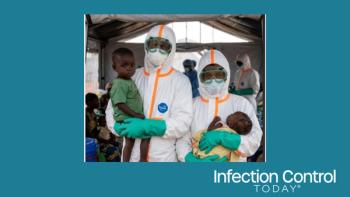
News|Videos|January 6, 2026
Beyond Gloves and Gowns: Rethinking PPE Training for High-Consequence Infectious Diseases
Author(s)John Parkinson
Jill Morgan, BSN, RN, of Emory University Hospital, explains why PPE education must start earlier, go deeper, and focus on supply, process, and competency to truly protect health care workers.
Advertisement
This interview first appeared on our sister brand,
When Jill Morgan, BSN, RN, stepped into her role caring for patients with high-consequence infectious diseases (HCID), she quickly realized how much of her own clinical training had overlooked one critical area: personal protective equipment (PPE). Despite years of experience as a nurse, she found that she and many of her colleagues had never been taught to distinguish between different levels of masks, gowns, or protective ensembles, or how those choices affect safety. Now the site manager for the Serious Communicable Diseases Unit (SCDU) at Emory University Hospital, Morgan is working to close those gaps by reframing PPE as a system built on supply, process, and competency, rather than a collection of disposable items.
“I realized that I hadn't paid any attention to that. I didn't know that there were different levels of masks or that there were different levels of gowns. I just in all my years of being a nurse, and there had been quite a few of them by then, it was just something that had escaped my notice. And I realized I'm not alone in that,” Morgan said. “An awful lot of people, both nurses, techs and physicians, really don't get much education about PPE, and so I think we need to do a better job, starting at the beginning, starting in nursing school and medical school, and really talking about what qualities are important, and what you should look for, and what that garment or article device can and can't do.”
In recent years, programs have come online to address caring for patients with HCID, including the proper donning (putting on) and doffing (removal) of PPE. Morgan has been involved in related initiatives. She is the colead of the PPE Working Group for the National Emerging Special Pathogens Training and Education Center (NETEC).
She says there are 3 pillars of PPE for treating patients with HCID: source of supply, processes, and training and competency.
For the supply source, the focus is on the PPE itself.
“You need to know what PPE is required for these different pathogens, and figure out with your supply chain, with your buying habits, with your staff, what you need, and then a lot of PPE does have an expiration date. So you need to figure out, how are we going to maintain that supply, how are we going to get the right sizes, where are we going to keep all this?” Morgan said.
For the process, it is all about donning and doffing PPE properly according to Morgan, and that leads into the third pillar of training and competency to teach all components of PPE.
“We have people [who] have been trying to teach this personal protective equipment ensemble and realize that they have many staff members who can't safely, for instance, reach their feet or shrug out of a coverall. Well, then that might not be either the right person or the right PPE to put in that space,” she said.
“I think a lot of folks got used to hearing the term PPE during COVID-19, the idea of gloves and gown and mask and maybe eye protection, but I think we still missed the importance of making sure that people were safely removing those things and not recontaminating themselves or their environment when they took things off,” Morgan said. “So how do we remove something? It's really important. And making sure people are competent in how they do that is really vital for their safety. It's not something that you can just leave off.”
Advertisement
Related Content
Advertisement



Advertisement
Advertisement
Trending on Infection Control Today
1
What Is Causing the 2026 US Measles Outbreak? Vaccination Rates, Travel, and Immigration Examined
2
Chasing the Bundibugyo Outbreak: How Static Numbers Hide a Moving Epidemic
3
Biocidal Hospital Surfaces and HAI Reduction: What a 10-Year NIH-Funded Study Found
4
Lost in Translation: Why CBIC’s New Education Rules Are Raising Questions in the Field
5