
What happens to a towel between uses? Natasha Terborg traces the laundry process from collection to storage and explains which practices from health care guidance can inform everyday laundry in shared facilities.
Health worker infections, threats against response teams, and gaps in triage are straining the DRC’s Ebola response. What can infection preventionists learn about protecting staff and keeping essential services open?
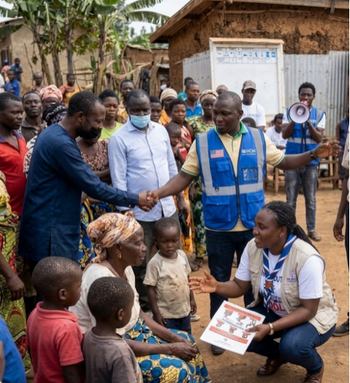
Frontline workers drive every outbreak response. Long before higher-level interventions arrive, nurses, physicians, lab technicians, and burial teams protect their communities on the ground. In the Democratic Republic of the Congo (DRC) (Map), these individuals are asked to hold the line under conditions that would break most health systems.
When I read the November 5, 2026, situation report from the DRC’s Institut National de Santé Publique (INSP) line by line, the cost on the ground to these first responders comes into focus. (Figure 1). In Tshopo, a hospital set aside a room to isolate the providers exposed during a post-mortem cesarean section. A confirmed frontline health worker from North Kivu was flown by private jet from Ituri to the United Kingdom for care. And in North Kivu, a hospital’s emergency department had closed with no alternative in place, while 18 of its staff sat in quarantine.1
As of November 6, the DRC has recorded 10,879 confirmed cases and 5302 deaths.2 On November 5, Africa CDC reported 427 health worker infections and 67 health worker deaths as of November 3.3 A week earlier, when Africa CDC laid out why this epidemic is not yet under control, the strain on the response itself was part of the answer. Only $1 billion of 3 billion dollars pledged to support efforts had been disbursed.4 That money went to the organizations carrying out the work, not to the DRC government. When the health ministry asked those organizations to account for it, only about a third reported, and more than $700 million remained unaccounted for. Africa CDC’s director general called it a transparency and reporting problem, said it was too early to speak of embezzlement, and warned that organizations that did not comply could be barred from the DRC.5
That leaves me with a question that feels uncomfortably familiar: what is being done to keep frontline responders safe?
What Puts Frontline Health Workers at Risk of Infection?
For clinicians, infection is a risk of the job. They willingly and knowingly enter into situations that can make them vulnerable to contracting an infectious disease. Infection tends to occur at times and in places where infection prevention and control (IPC) is hardest to practice: a crowded triage area, a home visit, a delivery room, or a body that has not yet been swabbed.
Recent reports from the past 2 weeks highlight a concerning pattern of exposure and infection among frontline health workers. In Haut-Uélé on November 4, response teams decontaminated a household and a health facility surrounding an infected frontline health worker, and a confirmed frontline health worker was admitted to an Ebola treatment center.6 Meanwhile, exposure assessments in North Kivu identified significant risks. On November 3, 41% of frontline health workers assessed were deemed high risk7; the next day, 50%.6 Additionally, in Tshopo, 3 high-risk frontline health workers were assessed at a local hospital in connection with the province’s 95th case.1
When IPC practices fail, exposed staff go into quarantine, and a facility loses vital staff it cannot spare. During an assessment of essential health services in North Kivu, the team observed a closed emergency department, inadequate staff protection, and that only 11% of staff were trained in IPC protocols.1
Access to prophylaxis and post-exposure treatment is not guaranteed. In Tshopo, 601 people have received post-exposure prophylaxis, and 66 confirmed patients have received experimental treatment, 63 with remdesivir and 3 with MBP134.1 Yet in the same province, 22 frontline health workers had to pause their prophylaxis treatment due to threats against response teams.8
What Happens When Responders Come Under Attack?
Concerns about physical safety are not new in eastern DRC, but the past 2 weeks illustrate how they affect the people the community depends on to deliver care. In Tshopo, physical attacks and threats against response teams led to the killing of a nurse by residents, according to INSP’s October 25 situation report.9 Part of an Ebola treatment center was later set on fire by youths from the community.10 By November 5, a community health worker’s house had been burned, and response activities in the area remained suspended.1 Also in Tshopo, youths broke into another Ebola treatment center to take back the body of a confirmed patient who had died, and police had to intervene.6
The situation in North Kivu is similar. On November 5, a grenade was found at the entrance of a health zone office, and burial and IPC teams again needed security escorts to perform their work safely.1 That night, an attack by an armed group sent several patients, including high-risk Ebola contacts, fleeing the center where they were under observation, according to a health source cited by INSP.2
Then there are the responders who can no longer keep working. Bas-Uélé is in the middle of a nurses’ strike that has paralyzed care across the entire province. In Ituri, an Ebola treatment center has not been able to provide case reports due to a provider strike. In Haut-Uélé, health care providers are threatening to strike over nonpayment.1
Not only do frontline staff fear for their physical safety, but they are also fighting just to be paid.
Can Facilities Hold the Line?
In infection prevention, the health facility is where everything converges. If triage fails to identify a patient at risk for Ebola, every interaction with the patient puts staff at risk of infection.
The assessment reports are sobering. In Bas-Uélé, 16 of 20 priority facilities have no functional triage, 17 lack a 72-hour water supply, and only 130 of 632 providers (20.6%) are trained in IPC. In Tshopo, just 8 of 107 facilities (7.5%) score above 80% on IPC.1 In Haut-Uélé, 7 facilities assessed on November 4 scored between 9.7% and 53.0%,6 and only 2 of 8 treatment centers meet standards.1
Treatment center bed capacity compounds the risk. Since October 24, North Kivu’s treatment centers have remained near capacity, ranging from 85% to 95% full. On each reported day, another 143 to 233 patients were cared for outside them (Figure 2). On November 4, the province had 595 patients in isolation, 210 of them outside a treatment or transit center.6
In other provinces, there may not even be an Ebola treatment center. Bas-Uélé is isolating 36 suspected patients in health facilities while its treatment center is still under construction. In North Ubangi, 12 patients are isolated at a general referral hospital because there is no treatment center in that area.1
Limited Protection on the Front Line
There is still no licensed vaccine or specific treatment for Bundibugyo virus disease. A phase 2/3 vaccine trial, TUMAINI, enrolled its first participants on October 23.11 In the meantime, the DRC is offering Ervebo to frontline workers through compassionate use and an effectiveness study.1 Ervebo is licensed for disease caused by the Zaire species of Ebola virus, and its US label states that it does not protect against other species.12 The WHO’s emergency guidance says there is not yet enough evidence to know whether Ervebo provides clinically meaningful protection against Bundibugyo.13
Vaccine access is uneven across the DRC (Figure 3). By November 5, North Kivu had vaccinated 2266 people against a target of 7105 (31.9%), with only 334 doses left and a resupply request pending. Bas-Uélé had reached 2000 of 13,202 targeted people (15.1%). Ituri had vaccinated 3023 people, but its target is still being redefined.1 Tshopo reported 13,036 vaccinated.2
What This Means for IPs
The DRC’s health workers are working with fewer resources than most of us can imagine, but the lessons are universal. If a patient with possible Ebola walked into your facility tomorrow, the same weak points would be tested: thorough clinical assessments, correct use of PPE, and staff training to triage or care for a rule-out Ebola patient.
Here are a few things to consider:
References