At the 2026 Healthcare Sterile Processing Association Conference in Baltimore, held from April 25 to 28, conversations around workforce development, professional identity, and education took center stage. For Rebecca Lauber, CRCST, CER, CIS, CHL, FHSPA, NREMT, LSSBB, and Vanessa Frank, CRCST, CHL, CER, CIS, those conversations are not theoretical. They are personal, practical, and deeply rooted in experience.
Rebecca Lauber Earns FHSPA and Champions Active Learning
At HSPA 2026, Rebecca Lauber, CRCST, CER, CIS, CHL, FHSPA, NREMT, LSSBB, marked a major professional milestone, earning her Fellowship in the Healthcare Sterile Processing Association (FHSPA). Her work reflects not only dedication to the field but a forward-thinking vision for how sterile processing education must evolve.
Lauber’s fellowship centered on a 29-page research paper focused on transforming technician education through active learning. Rather than relying on traditional methods such as lectures and test-based assessments, she advocates for a more engaging, hands-on approach.
“I wanted to shift education away from just reading materials and taking tests,” Lauber explained. “We need to create workshops, create moments where technicians are actively engaged, learning by doing, and truly understanding the work.”
Her research introduced scenario-based learning, often referred to as vignettes, which mirror real-world challenges technicians face. These exercises allow teams to work through problems collaboratively, reinforcing both knowledge and confidence. Lauber also incorporated hands-on workstations to bridge the gap between theory and practice.
Working in New York City, Lauber emphasized the importance of adapting education to diverse learning styles. “Not everybody learns the same way,” she said. “We have to build education around our technicians.”
For Lauber, earning her fellowship represents more than personal achievement. “Being a fellow means contributing ideas to the industry,” she said. “If we don’t share those ideas, we’re holding back progress in health care.”
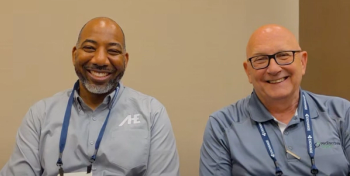
Frank, president of Keystone Alliance of Sterile Processing Professionals (KASPP) HSPA Chapter and the clinical resource manager for Advantage Support Services, Inc, a clinical resource manager with more than 13 years in the field, and Lauber, a robotics and operations manager at Mount Sinai Hospital, presented on career development and education in sterile processing, then they spoke with Infection Control Today® (ICT®). Both leaders emphasized that one of the greatest challenges in the profession is the lack of a clearly defined path forward.
“My presentation today was actually about career development in sterile processing, because it’s something that there really isn’t a path that is spelled out for people,” Frank said. “You get into the industry, and then you have to just wing it and figure out what you want to do.”
For many professionals, that lack of structure can feel limiting. During her presentation titled “Beyond the Sinks: Sterile Processing Career Development,” and her discussion with ICT, Frank explained that her career progression came from stepping outside traditional roles and embracing new opportunities through networking and conference engagement. “Through networking and making friends at these conferences, I managed to find another avenue, and then another avenue, and I have just exponentially grown,” she said.
Lauber echoed that sentiment, adding that mindset is often the biggest barrier as she talked about in her presentation, “Good Morning, Baltimore: Empowering the Stars of Survey Readiness.” “The only limiting factor is the belief that we can’t do it,” she said. “Apply for that job, even if you feel like you don’t qualify for it. You are your own limiting factor.”
Beyond career mobility, both speakers highlighted the importance of continuous learning and engagement. Growth in sterile processing does not happen solely within the confines of a standard work shift. “If you really want to grow in this industry, it does mean putting in work outside of your 8-hour shift,” Frank said. “You have to be involved with the industry. You have to know your [manufacturer’s instructions for use]. Ask questions. Connect with people.”
Education, however, must evolve alongside expectations. Lauber’s session on survey readiness focused on empowering technicians through active learning rather than passive instruction. “We need to empower our group. We need to involve them in active learning to ensure that they are survey-ready,” she said. “Not just hide them in the locker room. Not just say you’re not ready yet.”
Her approach includes scenario-based learning and hands-on workshops that reflect real-world challenges. “We create scenarios that technicians would deal with in real life and have them work through [them] together,” Lauber explained. “Not everybody learns the same way, so it’s very important that we form education around our technicians.”
This emphasis on empowerment ties directly to one of the profession’s most persistent challenges: recognition. Despite their critical role in patient safety, sterile processing professionals often struggle with visibility and professional identity.
“The biggest challenge is guiding our technicians to take themselves seriously as professionals,” Frank said. “We are done a disservice when people think we just show up and clean things.”
Lauber added that this perception can become internalized. “One thing I’ve seen a lot recently is people calling themselves dishwashers,” she said. “You’re not a dishwasher. You’re a professional. You have a certification and technical knowledge that keep patients safe every day.”
Leadership and culture play a critical role in addressing these issues. Without clear guidance and support, technicians may feel undervalued or disconnected from the broader health care system. “When we don’t have guidance for our leaders to give to their technicians, we create a culture where they don’t feel supported,” Lauber said.
Compensation and incentives remain additional concerns, but both speakers emphasized that motivation must extend beyond financial reward. “People ask what the incentive is,” Lauber said. “It’s not just about money. It’s about becoming a subject matter expert, taking what you’ve learned and applying it, and finding opportunities to make an impact.”
For both Frank and Lauber, the path forward is rooted in connection, education, and confidence. Professional growth begins with engagement, whether through conferences, chapter involvement, or platforms like LinkedIn.
“You have to force your way out of that mindset,” Lauber said. “Somebody out there needs your voice and your ideas.”
At HSPA 2026, that message resonated clearly. Sterile processing is not just a technical function. It is a profession driven by knowledge, collaboration, and a shared commitment to patient safety.