Sterile processing professionals face constant interruptions, cognitive overload, increasingly complex devices, and hundreds of IFUs. Randalyn Harreld, CRCST, FHSPA, explains why health care organizations must address the human factors behind SPD performance rather than expecting frontline professionals to simply absorb ever-increasing complexity.
Sterile processing professionals work in an environment where details matter, mistakes can affect patients they may never see, and interruptions are often unavoidable. Add staffing pressures, increasingly complex medical devices, lengthy instructions for use (IFUs), and a constantly evolving health care environment, and the cognitive demands can become significant.
Yet conversations about burnout and fatigue in health care often center on clinicians, nurses, and other patient-facing professionals.
Randalyn Harreld, CRCST, CIS, CER, CHL, CSPDT, CASSPT, CLS, AAS, FHSPA, clinical education manager for Steelco Belimed, believes sterile processing professionals need to be part of that conversation.
Harreld discussed burnout, human factors, interruptions, cognitive overload, and the growing complexity of sterile processing during a presentation at the Southern California Sterile Processing Association chapter meeting, held March 21, 2026, in Newport Beach, California.
“This particular topic, I think, is pertinent and is not something that we talk about enough,” Harreld told Infection Control Today® (ICT®). “We hear the studies and the conversations from the clinician side of things, and even with nursing. But I don't think we talk about it enough in sterile processing. Because we're such a labor-intensive and hardworking environment, I just felt like it's important to bring it up. I'm really passionate about it, and I think we need to be supporting our teams in this area.”
High-Stakes Work Without the Patient in Front of You
Sterile processing professionals may work behind the scenes, but the consequences of their work ultimately reach the patient.
That creates a particular type of pressure.
“SPD, and we could just put in infection prevention [and] infection control, is high-stakes, high-detail-oriented, high-pressure work,” Harreld said. “Everything that you're doing, it's a constant pressure, a constant high stress, and you're feeling the pressure of your responsibility.”
Unlike professionals working directly in an operating room or at the bedside, sterile processing technicians frequently don't see the patient who will ultimately depend upon the instruments they inspect, assemble, package, sterilize, and distribute.
“You don't get the sense of the patient in front of you, like working in the OR or surgical procedure or clinician,” Harreld said, “but you know that what you're doing is important.”
That combination of responsibility and distance can contribute to another issue Harreld discussed: becoming mentally disconnected from the work and its purpose.
The pressures don't occur in isolation. Excessive workloads, staffing challenges, emotional stress, interruptions, and organizational support can interact, increasing the burden on employees.
The Myth of Multitasking
One of Harreld's central messages concerned a constant in health care: interruptions.
A sterile processing technician may be assembling a complex instrument set when someone asks a question, the telephone rings, another department needs an item, or a coworker needs assistance. The employee then has to return to the original task. That doesn't necessarily mean the brain picks up exactly where it left off.
“We say, and I say this all the time, ‘I'm a multitasker, and I can multitask.’ And really, there's a study that talks about how humans, we're not multitasking; we're task switching,” Harreld explained. “That initial task that you were doing, what if you come back to it and you do it after 7 items later, 7 interruptions later? Did you do it with the same amount of quality as you did in the first one?”
In sterile processing, that question has obvious implications for patient safety. Harreld offered the example of assembling an implant tray containing approximately 200 components.
“You counted those first 40, then you get interrupted, and now you go back. You forgot where you were,” she said. “Now we're introducing rework. We're having to do all this rework.”
The problem isn't simply inconvenience. Interruptions can add cognitive demands to work that already requires sustained attention to detail. For leaders, that raises an important question: How much of what is characterized as individual error may actually reflect the conditions under which employees are being asked to work?
“We're All Feeling the Same”
Harreld incorporated survey responses from sterile processing professionals and others into her presentation. Respondents included technicians, leads, managers, directors, educators, vendors, infection prevention professionals, and individuals working across different types of health care facilities.
She initially hadn't planned to include the survey findings. Then she read the responses.
“The light bulb moment went off,” Harreld said. “I wasn't going to include the survey results originally in this presentation. And I read through the results, and I go, ‘Oh my gosh, we're all feeling the same.’”
Facilities differed, but Harreld saw recurring themes in the human-factor breakdowns respondents described.
One was assumptions.
“There's these things that people think about SPD or IP or in surgery, like, ‘Oh, I'm just going to assume that that person did it right,’ or ‘I'm going to assume that that piece of equipment is functioning properly,’ or ‘I'm going to assume that that infection preventionist did the rounding because they're supposed to,’” Harreld said. “We can't do that. We can't have those assumptions.”
For Harreld, discovering how much respondents shared also suggested an opportunity. Rather than treating burnout, interruptions, and other human factors as isolated problems within individual departments, the industry could begin discussing them collectively.
Has Reprocessing Become Too Complex?
When asked about the greatest challenge facing sterile processing, Harreld deliberately looked beyond the familiar answer of staffing shortages.
Her concern is the rapidly increasing complexity of the work itself. “We're faced with a rapidly evolving industry,” she said. “We've changed so much so quickly.”
Medical devices have become increasingly sophisticated, and the instructions required to properly process them can be extensive. “The level of the complexity in the devices is a part of the challenge,” Harreld said. “The second part of that is the instructions that we're expected to follow from these complex devices.”
According to Harreld, she has encountered IFUs ranging from relatively short processes to instructions containing well over 100 steps.
“There's no standardization,” she said. “While we have the FDA and we have the entities that mandate having the IFU, we have no consistency among the OEMs and the manufacturers from not only the device, but our detergents.”
Then add equipment, brushes, standards, guidelines, and the many other sources of information sterile processing personnel must understand.
“Just the complexity of the information that we are expected to know is getting harder, is getting faster, is getting more, bigger and longer,” Harreld said. “It's available. But how are we making it easier, and are we making it achievable to adhere to?”
A Case for Standardizing IFUs
Harreld believes the industry should consider whether IFUs themselves could become more standardized. She compared the idea with the structure of safety data sheets (SDSs), where users know where to look for particular categories of information.
“An IFU, there should be a standard, just like an SDS, a safety data sheet,” she said. “Section 1 is always the same. Section 7 is the same. You know where to look. We manage an SDS that every section is the same. Can an IFU be mandated to every IFU reading section 1 through 15?”
The challenge extends beyond locating information. Facilities must translate hundreds of IFUs, manuals, standards, and other resources into education, competencies, workflows, and daily practice.
“We have a lot of education. We have a lot of IFUs and manuals, and then we have our industry trying to take all of this information and figure it out,” Harreld said. “Everybody's in a silo, kind of doing their own thing at all these hospitals.”
The burden may be particularly intimidating for people entering the profession. “We're not doing a service to our new workforce coming in. It's very overwhelming,” Harreld said.
She acknowledged that today's expectations represent important progress for surgical patients compared with the less formal on-the-job approaches common decades ago. But the question now is whether the sheer volume of information has exceeded what individuals can reasonably manage.
“You go into any department, you can't tell me that you're reading the 450 IFUs every day and everything you're doing in the thousands of items that you have,” Harreld said. “You can't. We can't realistically do it. So, at what point do we have a better systematic, industry-wide approach to information?”
Designing Work Around Humans
Harreld isn't suggesting that facilities lower standards. Instead, she wants leaders to examine how work is designed so employees have a realistic opportunity to meet those standards. Among the strategies she discussed were standardized workflows, protected “safe zones” for concentration-intensive tasks, micro-rest periods, staff rotations, technology aids, checklists, improved access to IFUs, and stronger training.
Most importantly, she wants facilities to begin talking with their teams. “If they're being interrupted, and they are, it's part of your workflow. If your staff is tired or burnt out, try to come up with some strategies,” Harreld said. “Reinforce access to training and IFUs, and really support your team to make sure that they feel like they're getting the relief before you lose them and before you have an injury.”
Her final message extends beyond sterile processing to infection prevention and other high-pressure health care professions. “Let's just start talking about it,” Harreld said, “so that we can keep our IPs and our SPDs in our departments and not lose them.”
The goal isn't to eliminate every interruption, remove complexity from modern medical devices, or pretend high-stakes health care work can become stress-free. It is about recognizing that human performance has limits and designing systems that account for them.
Because when the work becomes increasingly complex, telling people to simply work harder or pay closer attention isn't a sustainable patient safety strategy.
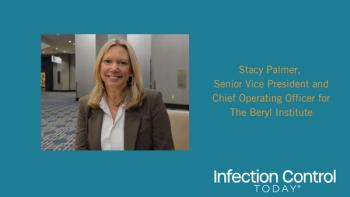
At AHE 2026 in New Orleans, The Beryl Institute's Stacy Palmer discussed 8 guiding principles for experience excellence and why EVS professionals influence far more than environmental cleanliness. Their interactions, workplace culture, and connection with patients help shape the overall human experience of health care.
This week on Infection Control Today, the stories ranged from emerging drug-resistant pathogens circling the globe to a landmark decade of surface science—all against a backdrop of ongoing outbreaks and a hard look at what the profession owes its own workforce.
During National EVS Week, appreciation matters, but partnership matters more. Environmental services professionals bring infection prevention expertise and a unique understanding of the health care environment that can help identify barriers, improve cleaning and disinfection practices, and ultimately protect patients.
Artificial intelligence can help IPs analyze surveillance data, identify patterns, improve training, and reduce repetitive work. Bassel Molaeb explains why AI literacy is becoming an important IPC competency while human validation, clinical context, and professional judgment remain essential.
At AHE Exchange 2026, ICT spoke with experts representing commercial laundry services, EVS, and infection prevention about the systems behind a successful reusable linen program.
They discuss linen quality, reject rates, unnecessary waste, frontline education, data, PAR levels, infection prevention oversight, and why strong relationships between health care facilities and their laundry providers matter.
A needlestick injury happens in seconds. Its cause may have started hours earlier.
Amy Piser argues that getting closer to “sharps injury zero” requires health care organizations to stop focusing solely on the moment of injury and start examining the systems surrounding it.
“Cutting” waste shouldn’t mean cutting people. At AHE Exchange26, David Green and Donald Sipp explored how EVS departments can improve performance by strengthening workplace culture, empowering employees, eliminating inefficient processes, and understanding EVS’s critical role in patient throughput. One case study showed bed turnaround times falling from nearly 2 hours to less than an hour, but the larger lesson wasn't simply about speed. High-performing EVS operations begin with a strong foundation.
At AHE Exchange26, experts revealed how surprisingly small gaps in linen education can contribute to waste, higher costs, and potential patient safety risks. The solution begins with something simple: helping everyone who touches health care linen understand why their role matters.