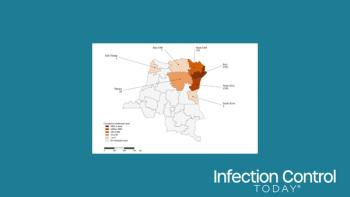
To provide context, the Kivus sit at the center of one of the world's most protracted humanitarian crises. For more than 2 decades, eastern DRC has been a battleground for numerous armed groups, and the resulting insecurity has displaced millions. By 2025, more than 7 million people will be affected, making it extraordinarily difficult to build stable health care systems or manage disease outbreaks.20
The impact, while gowns may be arriving, the training and IPC protocols required to use them safely are not yet reliably in place. What is the value of PPE in a supply room if staff have not been fully trained and deemed competent in donning, doffing, patient placement, and waste handling every single time? A supply gap is a failure in procurement; an IPC-readiness gap places staff at immediate risk of exposure and infection.
Ask any IP what happens next, and the answer is reflexive because we have all lived some version of it. You cannot isolate a threat you cannot confirm. Likewise, you cannot protect a workforce that your systems fail to keep safe.
The strain reaches past the supply room and into surveillance itself. The World Health Organization's (WHO’s) contact-tracing target is a 90% follow-up rate for identified contacts. In the first weeks of this outbreak, follow-up in DRC sat closer to 45%.12 By late June, it had climbed to 81.3%.10 The improvement is real and worth crediting. The lesson of that early gap is critical: it marks the difference between containing a transmission chain and allowing it to expand. Every unmonitored link increases frontline vulnerability. Ultimately, it leads to health care workers being exposed before the system even identifies the danger.
Frontline Resilience Amid Systemic and Security Constraints
Before the first case was ever confirmed, the system these workers hold up was already among the world's poorest-resourced. DRC has fewer than 1 physician per 10,000 people across most of the country. Per the DRC Ministry of Health's own accounting, only 3 of the nation's 26 provinces meet even that minimal benchmark.13,14 This is the workforce now tasked with staffing treatment centers, tracing contacts, and managing the dead. It is a system already stretched beyond its limits long before Ebola arrived, yet it was handed the most dangerous work in global health. By late June, its treatment centers were effectively full, with bed occupancy across DRC at 96.2% and North Kivu's units running at 138.8% of capacity.10
They endure conditions that would break most health systems. WHO Director-General Tedros Adhanom Ghebreyesus described a response unfolding amid intense violence and attacks on health facilities. Severe population movement makes tracking the virus nearly impossible. “We cannot build community trust or isolate the sick while bombs are falling,” he said.15 For a clinician in Ituri (home to one of the largest internally displaced person (IDP) populations in the world), this is their daily working environment. They navigate active security threats during a standard shift in a facility that remains a potential target.
Perhaps the hardest part is that the work itself breeds the mistrust that endangers it. International Medical Corps operates treatment centers in the outbreak zone and describes this trap plainly. When a patient enters a facility and never returns home, the community remembers the isolation rather than the medical intent. This happens because the disease kills the patient, meaning their remains cannot be safely released to the family. As a result, suspicion turns on the health care workers who took the loved one away. Some patients now run when isolation is mentioned.16 It is a cruel arrangement. This workforce must enforce strict containment and earn community trust at the same time, all within the very neighborhoods where they live.
And still, most stay. That is what the case counts never show and deserves to be clearly acknowledged. Health workers were among the first infected in this outbreak, and while some stopped responding out of fear for their lives, most did not.17 A 50-year retrospective on Ebola published in the New England Journal of Medicine in July makes a point of naming these individuals. The labor that carries every outbreak response and rarely appears in the formal record.18
The international surge is real, and it matters. However, reinforcements arrive and eventually leave. The local health workers were there before the response started. They will remain long after the international teams return home. They are the permanent frontline.
The Universal Lessons for IPs
Let me be clear about the risk first because it matters. The threat to any US facility from this outbreak is very low. The CDC and ECDC have both assessed the likelihood of an imported case reaching their populations as low. Furthermore, the handful of exported cases have almost all involved known occupational exposures among deployed responders. They did not involve community spread.8,19 It is a call to watch and to learn.
What is unfolding in Ituri is a live demonstration of the barriers that make any outbreak hard to stop. None of these challenges is unique to the DRC. These are universal lessons that every IP faces. Consider what this response is up against, and strip away the geography. An infectious disease spreads through the community faster than clinicians can test for or trace. Case confirmation is delayed because lab samples must be sent to another part of the country. Patient isolation or quarantine depends on the trust and cooperation of people who are frightened, displaced, or unconvinced that the virus is real.
For those of us working in health care back in 2020, this may sound familiar. When COVID-19 first entered our facilities, lab samples had to be sent out to reference labs. Furthermore, not all our patients consented to testing or agreed that the virus was real. This skepticism was never unique to COVID-19. It is the same challenge we face in tracing a measles exposure through an undervaccinated community. We see it when following up with a tuberculosis contact who has every reason to distrust the system. It applies to any control measure that only works if people believe us. Navigating fear and earning trust are not Ebola problems. It is the job.
That is the universal lesson. An Ebola response in a resource-limited, conflict-affected, low-trust environment is the same public health machine we all run. Here, it is simply stressed to its breaking point and made visible. When the margins are that thin, you can see exactly which part fails first. It is rarely the science. Instead, it is the supply chain, the follow-through of surveillance, and trust.
Therefore, I hope you will keep this outbreak on your radar. It is not because the virus is likely to arrive here. Rather, it is because this crisis teaches us in real time what our own systems depend on. The health workers carrying this response face severe shortages. They lack the infection-control readiness that turns simple supplies into safety. They are short on testing capacity. In too many places, they also lack the community trust that keeps them safe enough to work at all. This outbreak warrants our attention. The strength of any outbreak response is decided long before the crisis hits, in the infrastructure, systems, supplies, and the relationships we build every day.
References
1. Disease Outbreak News: Ebola disease caused by Bundibugyo virus, Democratic Republic of the Congo and Uganda. World Health Organization. July 3, 2026 (data as of July 1, 2026). Accessed July 3, 2026. https://www.who.int/emergencies/disease-outbreak-news/item/2026-DON612
2. Epidemic of Ebola disease caused by Bundibugyo virus in the Democratic Republic of the Congo and Uganda determined a public health emergency of international concern. World Health Organization. May 17, 2026. Accessed July 3, 2026. https://www.who.int/news/item/17-05-2026-epidemic-of-ebola-disease-in-the-democratic-republic-of-the-congo-and-uganda-determined-a-public-health-emergency-of-international-concern
3. Disease Outbreak News: Ebola disease caused by Bundibugyo virus, Democratic Republic of the Congo and Uganda. World Health Organization. June 13, 2026 (data as of June 10-11, 2026). Accessed July 3, 2026. https://www.who.int/emergencies/disease-outbreak-news/item/2026-DON607
4. Africa CDC and WHO launch joint continental Ebola response plan. World Health Organization. June 5, 2026. Accessed July 3, 2026. https://www.who.int/news/item/05-06-2026-africa-cdc-and-who-launch-joint-continental-ebola-response-plan
5. Africa CDC welcomes Pandemic Fund's US$220.6 million support for Bundibugyo virus outbreak response. Africa Centres for Disease Control and Prevention. June 5, 2026. Accessed July 3, 2026. https://africacdc.org/news-item/africa-cdc-welcomes-pandemic-funds-us220-6-million-support-for-bundibugyo-ebola-outbreak-response/
6. Ebola outbreak in DRC and Uganda: ECDC scales up support on the ground. European Centre for Disease Prevention and Control. Accessed June 30, 2026. https://www.ecdc.europa.eu/en/news-events/ebola-outbreak-drc-and-uganda-ecdc-scales-support-ground
7. Factsheet: EU response to the Ebola Bundibugyo virus disease outbreak. European Commission. Updated June 5, 2026. Accessed July 3, 2026. https://health.ec.europa.eu/health-security-and-infectious-diseases/crisis-management/ebola-virus-outbreak-2026_en
8. Ebola outbreak: current situation. CDC. Accessed July 3, 2026. https://www.cdc.gov/ebola/situation-summary/index.html
9. Ebola disease outbreak in DR Congo: MSF response, key facts, and timeline. Doctors Without Borders/Médecins Sans Frontières. Accessed June 30, 2026. https://www.doctorswithoutborders.org/latest/ebola-disease-outbreak-2026-how-msf-responding
10. Bundibugyo virus disease outbreak, Democratic Republic of the Congo | Uganda | France: weekly external situation report 07, data as of 28 June 2026. World Health Organization Regional Office for Africa. Accessed July 3, 2026. https://iris.who.int/bitstreams/6eda0efa-73d3-42dd-900b-b75f92b6b301/download
11. Nurses on front lines of Ebola outbreak at serious risk: ICN calls for urgent action. International Council of Nurses. May 28, 2026. Accessed July 3, 2026. https://www.icn.ch/news/nurses-front-lines-ebola-outbreak-serious-risk-icn-calls-urgent-action
12. WHO Director-General's opening remarks at the media briefing on the Bundibugyo Ebola outbreak, 3 June 2026. World Health Organization. Accessed July 3, 2026. https://www.who.int/news-room/speeches/item/who-director-general-s-opening-remarks-at-the-media-briefing---3-june-2026
13. The World Factbook: Democratic Republic of the Congo — physicians density. Central Intelligence Agency. Accessed June 30, 2026. https://www.cia.gov/the-world-factbook/countries/congo-democratic-republic-of-the/
14. Plan National de Développement Sanitaire recadré pour la période 2019-2022: Vers la Couverture Sanitaire Universelle. Kinshasa: Ministry of Health; November 2018. Democratic Republic of the Congo Ministry of Health. Accessed July 3, 2026. https://santenews.info/wp-content/uploads/2020/04/PNDS-2019-2022_GOUVERNANCE.pdf
15. Ebola outbreak in DR Congo collides with conflict and hunger, WHO warns. UN News. United Nations. May 28, 2026. Accessed July 3, 2026. https://news.un.org/en/story/2026/05/1167592
16. The battle against Ebola — and misinformation. June 2026. Accessed July 3, 2026. International Medical Corps. https://internationalmedicalcorps.org/story/the-battle-against-ebola-and-misinformation/
17. UN Geneva press briefing, 19 June 2026. United Nations Office at Geneva. Accessed June 30, 2026. https://www.unognewsroom.org/story/en/3165/un-geneva-press-briefing-19-june-2026/9439
18. Ebola at 50 — lessons for outbreak response and preparedness. N Engl J Med. Published online July 1, 2026. Accessed July 3, 2026. https://www.nejm.org/doi/full/10.1056/NEJMp2607819
19. Threat assessment brief: Ebola disease outbreak caused by Bundibugyo virus — Democratic Republic of the Congo and Uganda — 2026. European Centre for Disease Prevention and Control. May 21, 2026. Accessed July 3, 2026. https://www.ecdc.europa.eu/en/publications-data/threat-assessment-brief-ebola-disease-outbreak-caused-bundibugyo-virus-democratic
20. Democratic Republic of the Congo crisis response plan 2026. Geneva: International Organization for Migration; 2026. International Organization for Migration. Accessed July 3, 2026. https://crisisresponse.iom.int/response/democratic-republic-congo-crisis-response-plan-2026