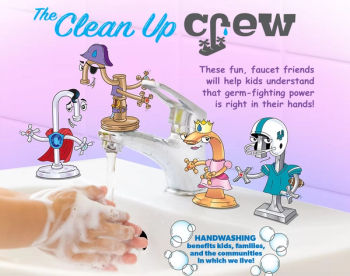
Artist and designer Matthew Caliman shares how personal loss inspired the Cleanup Crew, a handwashing education project using cartoon faucets, songs, and games to help families revisit an essential health message.
Zep Inc., a leading provider of professional-strength cleaning and maintenance products, announces that its Zep Commercial® division is offering two disinfectants for consumers that meet the criteria recommended by the Centers for Disease Control and Prevention (CDC) for the Ebola virus. These products are Zep Commercial Quick Clean Disinfectant and Zep Antibacterial Disinfectant Cleaner with Lemon.
“Due to the public’s growing knowledge and concern about new severe health risks like Ebola, we’ve seen a consumer preference trend toward commercial-grade cleaning products,” says John Callahan, vice president of marketing for Zep Retail. “Zep’s commercial-strength reputation comes from its history of making products that clean the most highly contaminated areas – hospitals, airplanes, schools, hotels, public bathrooms, and professional sports locker rooms. Zep has the unique ability to bring the power of commercial-grade products to consumers.”
“Prosumers,” or consumers who are interested in cleaning as effectively as professionals, have known for years that the Zep brand is synonymous with serious cleaning. With the growing awareness and desire for cleanliness and improved hygiene, prosumers are increasingly turning to professional strength cleaning products from Zep.
“Certain Zep products are capable of disinfecting both enveloped and non-enveloped viruses, which is the EPA recommended mix for fighting Ebola,” says Dr. Suhail Massad, vice president of research and development.
The CDC Interim Guidance for Environmental Infection Control in Hospitals for Ebola Virus states: “As a precaution, selection of a disinfectant product with a higher potency than what is normally required for an enveloped virus is being recommended at this time. EPA-registered hospital disinfectants with label claims of fighting non-enveloped viruses (e.g., norovirus, rotavirus) are broadly antiviral and capable of inactivating both enveloped and non-enveloped viruses.”
Labels for certain Zep products will mention effectiveness against viruses such as norovirus, rotavirus, adenovirus, and/or poliovirus, and directions for use for these viruses must be followed. We are not aware of any EPA-registered disinfectants, including Zep products, which contain a specific kill claim on their label against the Ebola virus.
Zep products, such as Zep Commercial Quick Clean Disinfectant, are also specially formatted to make cleaning more efficient. Users simply spray or mop a hard, non-porous surface and then wipe after waiting a short but specific time needed to kill certain bacteria and viruses – from as quick as 5 seconds up to 2 minutes. Requirements on the time needed per bacteria or virus are clearly indicated on the product label.
Zep Commercial Quick Clean Disinfectant is the newest Zep cleaner now available to consumers. It is sold in a 32-ounce spray bottle and a one-gallon container at hardware, select independent retailers and home improvement stores nationwide, including The Home Depot, Lowes and Tractor Supply Company. The 32-ounce spray bottle retails for an MSRP of $3.47 and the gallon size retails for an MSRP of $8.98.
Source: Zep Inc.