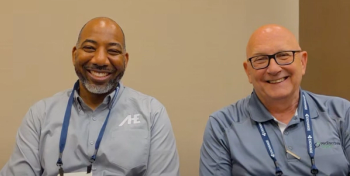
Choosing a disinfectant can expose a gap between standardization and adherence with manufacturers’ instructions for use (IFUs), Diane Cullen, JM, MSN, MBA, RN, CIC, CPHQ, explained during an interview with Infection Control Today® at the Association for the Health Care Environment (AHE) Exchange26, AHE Education & Solution Summit conference held in New Orleans from August 16 to 19, 2026.
Cullen, clinical development manager at Metrex, discussed a presentation, “Manufacturers’ Instructions for Use—Is Compliance Possible?” developed with colleague Whitney Casey, senior manager, product portfolio and clinical success for Metrex Research, LLC, that explores whether a single disinfectant could meet the requirements of IFUs. According to Cullen, Casey evaluated more than 500 manufacturers’ instructions for use (IFUs) from approximately 15 facilities and found that a single disinfectant could not satisfy all requirements reviewed.
Top 3 Takeaways
- One disinfectant may not meet every IFU requirement. Cullen described a review of more than 500 IFUs that exposed challenges with using a single product.
- Risk assessment should consider 6 criteria. Cullen’s approach weighs compliance, patient safety, staff safety, resources, workflow, and clinical effectiveness. Documentation does not eliminate the possibility of survey deficiencies.
- IP and EVS need shared decision-making. Involving leadership and other departments helps organizations understand operational challenges and document the reasoning behind their choices.
That finding prompted a discussion about how organizations can navigate competing priorities. Cullen advocated a weighted risk assessment encompassing 6 criteria: IFU adherence, patient safety, staff safety, resources, workflow, and clinical effectiveness.
“Our goal is not to discount IFUs. My goal in this presentation is to say IFUs are important, so is everything else. So how do we make this decision defensible?” she said. Her approach asks organizations to consider their circumstances when weighing those criteria, including budget constraints, staff turnover, and survey findings.
Cullen emphasized the importance of involving stakeholders and leadership while documenting the reasoning behind decisions. “It's important to document that you made that decision and why you made that decision,” she said.
She described APIC’s toolkit as foundational to the project, explaining how the presentation builds on that work: “I think what we're doing is trying to give organizations a way to articulate why it is they're making the decision that they're making.” She also acknowledged that organizations could still face survey deficiencies.
Beyond the presentation, Cullen said attending Exchange26 offered opportunities to understand environmental services (EVS) challenges firsthand. “I think it's important for infection prevention to reach across the table, come in here, and see what they're talking about,” she said. Those conversations reinforced the value of partnerships across EVS, nursing, facilities, finance, and sterile processing.
Cullen encouraged infection preventionists to learn what colleagues face and recognize their shared goals. “Infection prevention does best when it works with others in the organization. It is a team sport,” she said. For Cullen, understanding those perspectives is central to making decisions that reflect organizational needs.