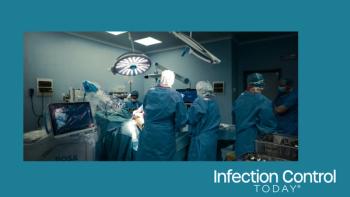
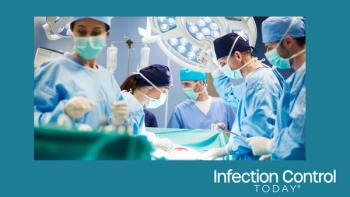
At the 2025 Association for periOperative Registered Nurses (AORN) Global Surgical Conference in Boston held from April 5 through 9, Michael Sinnott, MBBS, FACEM, FRACP, associate professor at the University of Queensland and the Queensland University of Technology, and the cofounder of StaffandPatientSafety.org, delivered a message that struck a deep chord across disciplines: "There can be no true culture of patient safety without a culture of staff safety."
Speaking passionately with Infection Control Today®, Sinnott outlined a powerful evolution in thinking that urges the operating room to adopt what he calls a “One Safe Culture,” where the safety of staff and patients are not competing priorities but codependent necessities.
“Our big belief is that safety is a thinking small and a culture, and so by allowing yourself to think about safety with staff, it'll increase your ability to think safety for patients. So, we think one leads to improvement in the other,” Sinnott said.
Sinnott’s perspective stems from over a decade of advocacy and research. As early as 2014, he published in the British Medical Journal that patient safety efforts fall short when staff safety is neglected. He illustrated this contradiction through what he dubbed the “blameworthy paradox.” While hospitals promote a no-blame culture to encourage the reporting of medical errors that affect patients, staff injuries—such as sharps incidents—are often internalized and unreported due to self-blame and stigma.
Instead, Sinnott highlights the “idea of the no-blame culture. This meant that if I made a mistake and a patient had a bad outcome, or if I made a mistake and there was no bad outcome, I should tell my boss. So instead of yelling at me, my boss should say, ‘Let's sit down with a couple of other interested parties and a couple of experts and work out how we can design something so you won't make this error again and no one else will.’”
This paradox is not just philosophical—it has real consequences. In the US alone, approximately 385,000 sharps injuries are reported each year. Sinnott estimates that the actual number is likely double that, as over half go unreported. These injuries can result in serious infections such as hepatitis B, hepatitis C, and HIV, and the lack of documentation means little is done to prevent future incidents.
Sinnott advocates that safety must become a mindset shared across every level of care. Drawing on James Reason’s “Swiss Cheese Model” of system failure, he emphasized the need for layers of protection—not just for patients but for staff. “I think the biggest challenge is a lack of respect for their own safety,” Sinnott said.
His latest proposal is deceptively simple but transformative: incorporate a staff safety checklist into the WHO Surgical Safety Checklist. “We should have a couple of staff safety checks in that list to improve staff safety because we believe that staff safety should be improved in its own right, but it will also have the added effect that it will also improve patient safety,” Sinnott said. Based on surveys of nurses in the UK and Australia, the top priorities for inclusion were smoke evacuators, face shields, and single-handed scalpel blade removal systems.
During a visit to a vascular access institute in South Carolina, Sinnott observed firsthand how staff vigilance could reinforce this safety culture. A scrub nurse calmly noted that Sinnott wasn’t wearing a face shield and non-judgmentally asked why. That moment sparked the realization that staff safety practices could—and should—be as embedded in surgical routines as patient counts or site verification.
One of Sinnott’s more sobering revelations came from a survey showing that 6 in 10 nurses still remove scalpel blades with their fingers, despite OSHA's 2023 update explicitly stating that fingers, Kelly clamps, and needle holders do not meet the standard for safe removal. “By allowing yourself to think about safety with staff, it'll increase your ability to think safety for patients. We think one leads to improvement in the other,” Sinnott said.
But that mindset is slowly changing, a shift Sinnott attributes to the “silver lining” of COVID-19. The pandemic heightened awareness of staff vulnerabilities, and for the first time, the general public began to view clinician safety as integral to quality care. “[Staff] became a little bit more aware of the importance of staff safety. And so now we see a little bit of overlap in the two circles, but we really need to see those circles superimposed,” he emphasized.
To bring about this cultural change, Sinnott believes education is critical, but so is emotional reframing. Sinnott said that they ask nurses, ‘Would you want your child working in unsafe conditions?’ Or, ‘Do you believe your colleagues deserve safety?’ When the answer is yes, it opens the door to valuing their own safety too.
Sinnott praised AORN for being one of the few organizations to consistently platform the staff safety movement. “AORN has always been very supportive of what once was an outlying opinion, and so with their support, hopefully, it's becoming more accepted that staff safety is important and that we should be aiming for one safe culture for everyone—staff and patients.”