
News
Advertisement
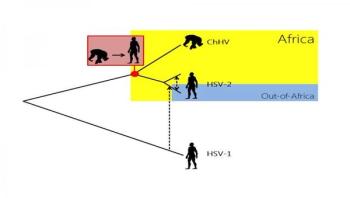
It's an axiom of the infectious disease research community that wherever humans go, germs are likely to follow. Such is the case with the herpes virus family. There are two main strains, herpes simplex virus 1 and 2 (HSV 1 and 2). HSV1 is mostly transmitted by mouth, and seen most often in the common cold sores (affecting two-thirds of the world's population). HSV-2 is the main culprit of genital herpes (global prevalence of 11 percent), but has even been used to help verify the accepted ancient migrations of humans "Out of Africa" dogma that began about 80,000 to 50,000 years ago.
Advertisement

HIV is a master of disguise. The virus uses a shield of sugar molecules, called glycans, to hide from the immune system and block antibodies from attacking it. Now, scientists at the Scripps Research Institute (TSRI) have developed a method to analyze the glycan shield on HIV's protective outer glycoprotein, developed as a potential HIV vaccine candidate.

Researchers have identified proteins that enable deadly malaria parasites to 'walk through cell walls' - a superpower that was revealed using the Institute's first insectary to grow human malaria parasites. The research has identified two parasite proteins that are the key to this superpower. The proteins could be targeted to develop much-needed antimalarial drugs or vaccines.
Advertisement

Antimicrobial Resistance Diagnostic Challenge Selects 10 Semifinalists in First Phase of Competition
Ten semifinalists have been selected in the first phase of the Antimicrobial Resistance Diagnostic Challenge, a federal prize competition that will award up to a total of $20 million in prizes, subject to the availability of funds, for innovative rapid, point-of-need diagnostic tests to combat the emergence and spread of drug-resistant bacteria. The semifinalists were selected for their concepts for a diagnostic based on a technical and programmatic evaluation from among 74 submissions. While semifinalists will each receive $50,000 to develop their concepts into prototypes, anyone can submit a prototype to compete in the second phase of the challenge to win up to $100,000.


When Chlamydia trachomatis infects a human cell, it faces a huge challenge: It must prevent the cell from triggering programmed cell death to prevent the bacteria from replicating and spreading throughout the body. Since numerous metabolic processes are either missing or fragmented in the pathogen, it is reliant on the host cell to supply the vital nutrients on a permanent basis.

Blood-sucking flies can act as 'flying syringes' to detect emerging infectious diseases in wild animals before they spread to humans, according to research published in the journal eLife. The discovery has significant implications for our ability to control the global outbreak of new and re-emerging infections such as the Ebola and Zika viruses.

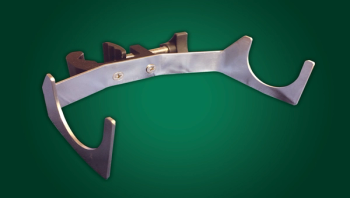
Q: Recently, I refused to process a device based on the following manufacturer’s instructions provided: “The xxx parts are made of durable aluminum and can be cleaned with ultrasound and any cleaning agents. Any standard sterilization technique is acceptable. There are no moving parts to maintain.” I contacted the company to alert them the instructions for use (IFUs) were insufficient. The company replied that “reprocessing is a different concept from cleaning and sterilizing a simple instrument for reuse.” They stated that the particular instrument in question “is a simple "instrument" like a retractor or a mallet. These instruments are reused; do not have critical "parts" that need to be retested between uses. They need to be cleaned and sterilized. It is a simple device with no moving parts or cavities or other complicating factors. How does one handle this?
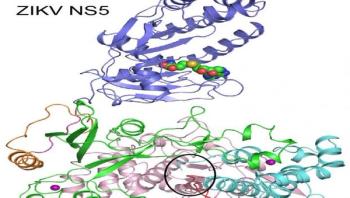
Zika virus (ZIKV), which causes Zika virus disease, is spread to people primarily through the bite of an infected Aedes aegypti or Aedes albopictus mosquito. An infected pregnant woman can pass ZIKV to her fetus during pregnancy or around the time of birth. Sex is yet another way for infected persons to transmit ZIKV to others.
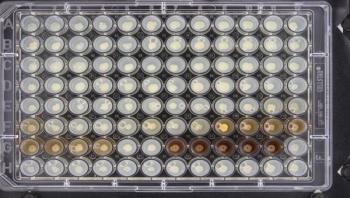
New UBC research on bacteria that cause major problems for those with cystic fibrosis reveals clues as to how it proliferates for so long in the lungs and offers new ideas for treatments to explore.

Patients who are discharged after a hospital stay will want to stay away from the hospital for as long as possible. However, in Singapore, approximately 15 percent of patients who have been discharged from hospitals will succumb to a readmission within 30 days, while globally, readmission rates within 30 days can be as high as 20 percent.

The concept that infection prevention and patient safety is everyone's responsibility is nothing new, but some healthcare institutions may still be struggling to foster and nurture a culture of safety that permeates every department and every function. Taking the lead are directors and managers in patient safety and quality improvement, but infection preventionists (IPs) must also retain a prominent position as stakeholder in the process.

Maintaining normothermia of the surgical patient is part of the prevention of surgical site infections, and a study by Steelman, et al. (2013) found that perioperative hypothermia was among the top patient safety issues identified by perioperative nurses. In this study, AORN members employed in ambulatory and hospital settings (N = 37,022) received an electronic survey; of the 3,137 returned surveys that contained complete information, 966 respondents (30.8 percent) identified prevention of hypothermia as a high priority. However, debate over the safety of forced-air warming systems continues, and clinicians should first and foremost consider all sides of the argument when making product evaluation and purchasing decisions. Alternatives to forced-air warming include direct-conduction fluid warming systems and systems that use conductive fabric technology. Conductive fabric systems do not require the use of a disposable blanket, which can help reduce waste and keep costs down.
Advertisement
Advertisement
Trending on Infection Control Today
1
What Is Trichophyton indotineae? Drug-Resistant Ringworm Spreads to 29 Countries
2
What Is Causing the 2026 US Measles Outbreak? Vaccination Rates, Travel, and Immigration Examined
3
Infection Control Today Launches First Digital Magazine for Infection Prevention Professionals
4
ICT Weekly Rounds – September 17, 2026: RIngworm, Measles, Ebola Updates
5