
News
Advertisement
Advertisement
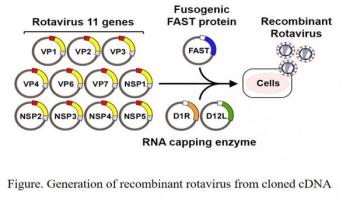
Rotaviruses are the most common cause of severe diarrhea and kill hundreds of thousands of infants a year. Although current vaccines are effective in preventing aggravation of rotaviruses, the development of more effective vaccines at lower cost is expected. Technology cannot study well how rotaviruses invade and replicate in a cell. To identify which genes are crucial for the infection of rotaviruses, scientists at the Research Institute for Microbial Diseases at Osaka University report a new plasmid-based reverse genetics system. The study can be read in Proceedings of the National Academy of Sciences of the United States of America.
Advertisement
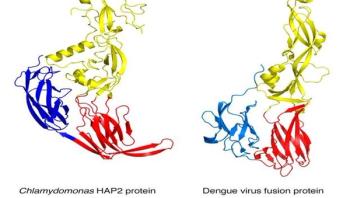
Sexual reproduction and viral infections actually have a lot in common. According to new research, both processes rely on a single protein that enables the seamless fusion of two cells, such as a sperm cell and egg cell, or the fusion of a virus with a cell membrane. The protein is widespread among viruses, single-celled protozoans, and many plants and arthropods, suggesting that the protein evolved very early in the history of life on Earth.
Advertisement

Contact tracing -- a process of identifying everyone who has come into contact with those infected by a particular disease -- combined with targeted, indoor spraying of insecticide can greatly reduce the spread of the mosquito-borne dengue virus, finds a study led by Emory University researchers funded by the National Science Foundation (NSF).
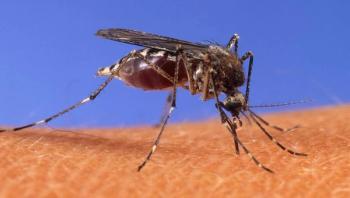
The mosquito Aedes aegypti, which can spread dengue fever, chikungunya, Zika fever, and yellow fever virus, requires a blood meal to develop eggs. One way to control the spread of these diseases is to tamper with the reproductive events that follow this mosquito's blood meal. This is what a team of scientists at the University of California, Riverside has explored at the molecular level. The researchers focused on small regulatory RNA molecules, called microRNAs, which play a critical role in mosquito egg maturation.

The human whipworm, which infects 500 million people and can damage physical and mental growth, is killed at egg and adult stage by a new drug class developed at the Universities of Manchester and Oxford and University College London.
Advertisement
Advertisement
Trending on Infection Control Today
1
What Is Trichophyton indotineae? Drug-Resistant Ringworm Spreads to 29 Countries
2
What Is Causing the 2026 US Measles Outbreak? Vaccination Rates, Travel, and Immigration Examined
3
Infection Control Today Launches First Digital Magazine for Infection Prevention Professionals
4
ICT Weekly Rounds – September 17, 2026: RIngworm, Measles, Ebola Updates
5